


We have more on cameras that we just haven’t shared as yet. But we will in due time. Why? Because there are improvements all the time and also creativity with innovation.

We have more on cameras that we just haven’t shared as yet. But we will in due time. Why? Because there are improvements all the time and also creativity with innovation.

Introduction
The risks of valuables transportation services (cash, jewelry, intellectual valuables etc) along with valuable replenishment services (ATM cash replenishment and retrieval) to name a few are high as are the cost for the services.
Specifically Cash In Transit (CIT) or the service activity of transporting money for legal entities is a large business due to the level of risk. This normally requires many factors to reduce those risks. But with cost as a consideration viability normally could reduce the measures that are taken. Thereby directly increasing the risk.
The task normally consist of the pick up activity (This is where verification actvities and accountabilty take over activities are carried out.), the actually transportation activity (This would be remaining vigilant, Protecting, driving and avoidance) and finally at the destination is the Handover activity (where verification again take place, accounting and transfer of responsibility)
In Malaysia additional activities that are also outsource to guard companies the actually loading of money into ATMs. Hence even more risks are exposed.
Risks
Some of the risks that arise are : –
Any activity dealing with cash or valuables and not handled by the owner themselves bring about the following: –
Addressing the Risks
Even though the activity may bring risk the rewards can also be fulfilling for the right people. To ensure the risk is worthwhile and to reduce them some measures must be taken. The following are the ones taken today:-
Raising the Bar
In addressing the act of raising the bar beyond the cost of vehicle, fuel and man hour rate, There is more to be provided with justifiable cost increase but higher benefits in terms of security and possible reductions on other protection received as rewards in reduced insurance premiums and more for the companies involved.

Tool, Tracking and Reporting (TTR)
Though there were 4 other items of main issues and measures needed to be addressed , we will only deal with the fifth one which is Tools, Tracking and Reporting. Though it is not said that there is none today (And there cannot be no measures in place), the measures used could be updated and upgraded to increase transparency, insert digital tracks with alarms when conditions not met and reporting of the overall activity (in action and when action completed).
The three main components to be enhanced is the vehicle traceability, the cargo with path validation and personnel support. This by tagging with real time tracking visually, audio and GPS positions. of all components involved in the service/activity.

With all those components in place the hidden or unknown better yet described limited information for verification previously available possible due to technology. The increase of it in tandem with the tried and proven processes, illuminated by the current availability to provide real time viewing with evidence (real time and post time) of the service being carried out.
But not withholding the best improvement yet, the ability to provide remote support when the risky events occur. Such as calling in relevant personnel and parties when robberies or interception of the valuables occur.
This in itself will increase the risk factor to the criminals and increase the safety factor to all provider personnel and customer valuables.
But though it may improve capabilities. It does not eliminate the original risks at all.
What to know more about the solution or have a quotation for implementation? Email us at enquiries@kanshare.com
Note the products and solutions displayed are provided by manufacturers and distributors as products for our reselling and deployment in solutions designed in part or integrated as a whole from one or many ideas.
The brands or indicators/inference of a particular brand does not mean that the solution or component for that part of the solution can only be delivered by that brand or inferred brand.
Cost, preference and other factors may drive variation to the frame of ideas elaborated above.
CCTV systems have increased in the features that provide for specific functions. They range from low light (IR or sensitive CCD/CMOS sensor), facial recognition, stock count keeping automatically updating the stock levels, to motion detection and many more features.
Today the latest entrant to those features is temperature and humidity monitoring. This is especially useful for environments that require the ability to capture and monitor these changes. Industries that can make good use are from farming to monitoring environmental changes to sensitive products such as wineries, rooftops, computer rooms, telecommunication centres, utility centres and more.
More coming soon on this topic.

Latest update contained in this link
This is a follow on from our previous article CCTV Basics http://kanshare.com/Solutions/cctv-basics-ip-cctv/
Today is about power and video. First is power. Everything needs power.
The most basic CCTV setup is the distributed power setup. This is easier as you grab power from the nearest socket or extend from the nearest power socket or lighting point.
The next format is the centralised power supply system. This requires wiring from camera all the way back to the central power supply. Generally you drag one cable for one camera. There are occasions some may split the power to cameras along the way. But this method is the surest way to having problems in the long run. In terms of trouble shooting and also the more technical which is power drop.

Below are the types of cables that can be used for a power solution for CCTVs. But they all have their particular use, methods of use and characteristics. A little more descriptions as enclosed in the slide.

Now as power has been provided separately. The choice of video transmission is equally varied. And basics limit the options to the relevant technology. But in over the years innovative solutions such as transmitters receivers, converters and baluns have allowed cross transmission of video on different cable and wireless solutions.

Even further creative uses of older technologies have even provided the single wire solution for both Power and Signal. And they totally differe from the analog twin signal and power cable.
These technologies actually transmit the both the power and signal over the very same cables.
POE. Power Over Ethernet uses the friendly computer cable to make connection between the recorder/viewing station. As the name says there is power and signal transmitted over the ethernet cable with RJ45 connectors.
PLC Power Line Communication or sometimes known as the HomePlug. Transmit both the video and power over the normal house power line. Very stable. Hardly any wiring required in addition to whats there.
POC/EOC Power Over Coaxial and Ethernet Over Coaxial. Now the former is relatively new as traditionally you did not send power over any coaxial cables. Reasons very obvious which you can read up more on the purpose of cables and their types. (You could wiki it and more. Maybe we will do a little write up in the future.) The later Ethernet Over Coaxial is relatively old as it is similar to the token ring network with the exception of the speed and the finickiness of token ring which required very strict cable types, lengths and terminators on each end.
We have written a little bit about this in brief for our customers. But soon there will be some publishing on this here too. Look out for it.

All in all to sum up, the security market today is beyond national deployment in the more staid governmental policing and army. Nor is it the sole commercial controlled security services industry which requires trained personnel (which it used to have and abundance of source in the past. Today they require huge investments into training which is sometimes daunting).
You now have an array of solutions to put part of the monitoring of your security in your hands. And to support the organised bodies to enhance their reach to keep everyone safe.
Got a query or need? Email us at enquiries@kanshare.com.
Are you a property agent? Does your potential client and their customer find it difficult to schedule all parties in for an initial viewing? Looking for an alternative?
We have an answer. Use CCTVs with cloud access for initial viewing. Use Skype and other such tools for extending your reach (even around the world) and give flexibility to all parties in viewing potential closings.
1. For inhabited properties schedule a time for the CCTV you put in to be turned on for the viewing. When viewing is done, get it turned off again.
2. For uninhabited put in a Mobile internet solution with your cctv solution on all the time ready for viewing. The added advantage you can provide over your competitors to your client? Add on free security till you close the case.
Works for both rentals and sales. And it does not need to be installed permanently at all. We have solutions for temporary installations that do not damage the property and is easy for you to move from one location to another.
Anything there are problems? Just walk it in to our office for a free of charge trouble shooting.
Interested? Email us at enquiries@kanshare.com
IP CCTV in its basic form isn’t basic till bare bones. It in general has a rich feature list that in the analog CCTV offering would be considered rather advanced.
Why where the basic analog cctv which today is now way advanced from its predecessors, the IP CCTV is based on a form of computer and immediately some networking.
That in its base form gives you immediate increase in features. They start immediately by being networked hence easily integrated into a normal IP data network. When in that network its access is easy but along with that easy access there is already some basic authentication requirements unless turned off or given a standard default.

CCTV BASICS – IP CCTV
It can work as a stand alone system right from the start. It provides security to access it, it has open standards to viewing such as pcs, laptops, smart devices such as smart phones, tablets and also dedicated devices. Even recording can be on any device beyond dedicated devices.
Increasing number of view points and devices to capture as well as view is pretty simple.

CCTV Basics – IP CCTV
After adding the devices this is where it can be pretty back to front as opposed to the analog systems. To have a dedicated recording and playback monitoring device now you add a dedicated recorder or multiplexed switching NVR (Recorder)

CCTV basics – IP CCTV
Today the IP CCTV options are so diverse includes wifi based systems and more. Especially visible in the stand alone systems from the more reknown IP product manufacturers where they provide you a wired option in addition to your wireless option(wifi).
Even on the wired option they have improved to provide reuse of as much legacy infrastructure (Coaxial cables, power sockets and more) to make the migration to getting more out of your cctv and giving your monitoring more freedom yet the ability to stay static and have escalated viewing functions.
Its level of mobility is high to being accessible far and wide locally via wire or wifi till the internet on a peer to peer basis (with complicated configuration) or simplified cloud solutions. Its all in your hands.
Got you interested read more in our other article
Have enquiries? Send them all to enquiries@kanshare.com
Close Circuit TeleVision is a tool used in security and monitoring.
 In its most basic form just had a camera a screen on the other end, wires to interconnect the devices and power to both end. On the monitor end the connectors started from a coaxial version to a converted variant to RGB format using RCA connectors to d-subs. No recording.

CCTV Concentrators with switcher functions.
As the need for more points to be viewed at a time as less men were deployed then came concentrator boxes such as switchers to switch between camera views. This reduced the installation of screens and one to one deployments of viewing devices. It also brought focus back to the security monitoring team. But it still left a hole during the switch over time. The first versions were manual then came the auto versions based on timers and other logic.
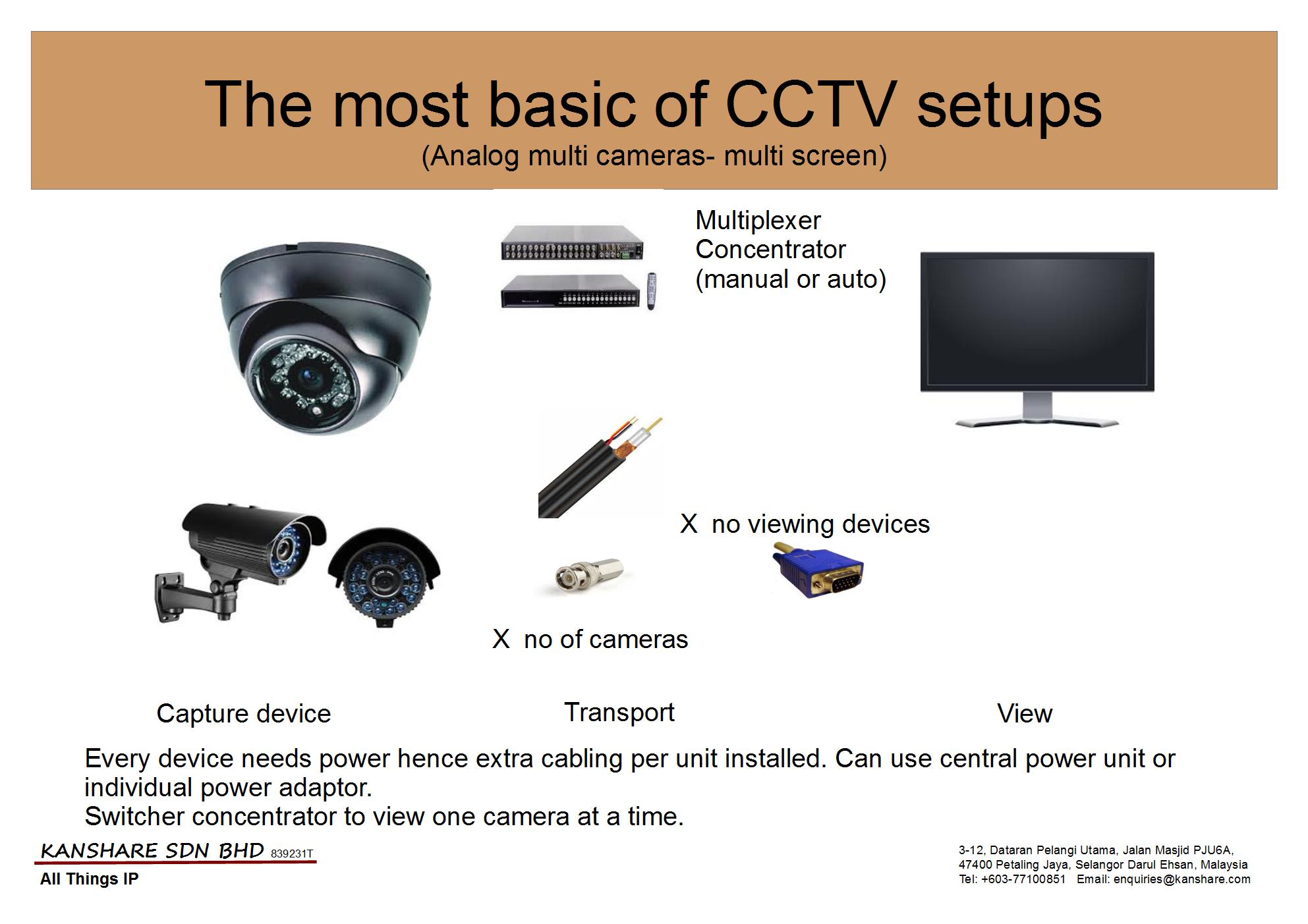
Multi screen CCTV
As the need to simplify, shrink foot print of equipment install base, multiplexers were the next innovation on the viewing end of the cctv solution. This gave more than one camera view on one screen. Married with switchers this kind of concentrator gave more options and less security breach opportunity as the viewing was for longer periods of time per multi view.

CCTV multi screen with recording
After the evolution of dispersed viewing providing more tools to the security personnel providing a total security solution, evidence was required for prosecution and more. This is where the recording function appeared as the requirement. This combination did not change very much with the exception of accessories such as controllers(joy sticks, keypads, mouse pads, keyboards etc), zoom tools and more.
Today in the analog arena you have High definition video solutions currently the common resolutions are 1Mp (720p), 1.3Mp (960p) and 2Mp (1080p also refered to as full HD).
Analog solutions also have some wireless solutions. Most on radio transmission up to microwave solutions that are commonly proprietary.
Next article is CCTV Basics – IP CCTV
 Today where technology has advance so far and the density of human population per square foot increases year on year, the choice to increase security solutions and also put it in your hands rather than hands of strangers is higher.
With the options available it can be confusing and daunting.
KANSHARE SDN BHD has taken the bull by the horns and has taken into its line up single wire CCTV solutions.
What is single wire IP CCTV solutions?
Normally a typical cctv solution requires a viewing capability. That would be refered to as the video (data traffic) images. That would go on one kind of cabling to a recorder with or without a screen. Then to have the device function such as the camera and the recorders they would require power.
Now power can come as a individually prepared power socket that an individual device power adaptor would connect to it or it could come from a central power unit.
Each of these would require one set of cables for data and one for power.
With the single wire CCTV solutions the single wire you pull will carry the power and the video (data traffic) images.
We have single wire for most conditions. They are:
Now what ever solution you choose will end up in a recorder refered to as an NVR (Network Video Recorder. Formerly known as a DVR (Digital Video Recorder) in the digital/analog cctv solution.)
Todays recorder not only records, it is a central controller, it joins many images in one view (multiplexer), it also rotates between views (switcher/patrol function), it also provides remote viewing on a peer to peer basis from local to local view and local to remote view (anywhere far away from your home network). It also provides a cloud solution to simplify your connecting requirements from a far off place to your home or work space for what ever reasons you may have.
They are even mobile, with positioning but that is for another topic in our future.
Also to have more details on how each technology is connected and functions in as simple a manner that we can. Keep a look out for our future posts.
For an example of products supporting those technologies follow the links below. Else send us a enquiry at Enquiries@kanshare.com
General Products
http://kanshare.com/Products/
The grade and quality varies but we are sure we have one that will meet your needs. Pushing 2mp (1080p) and higher, but we still do have lower 1.3 (960p), 1.0 (720p) and analog/analogHD.
